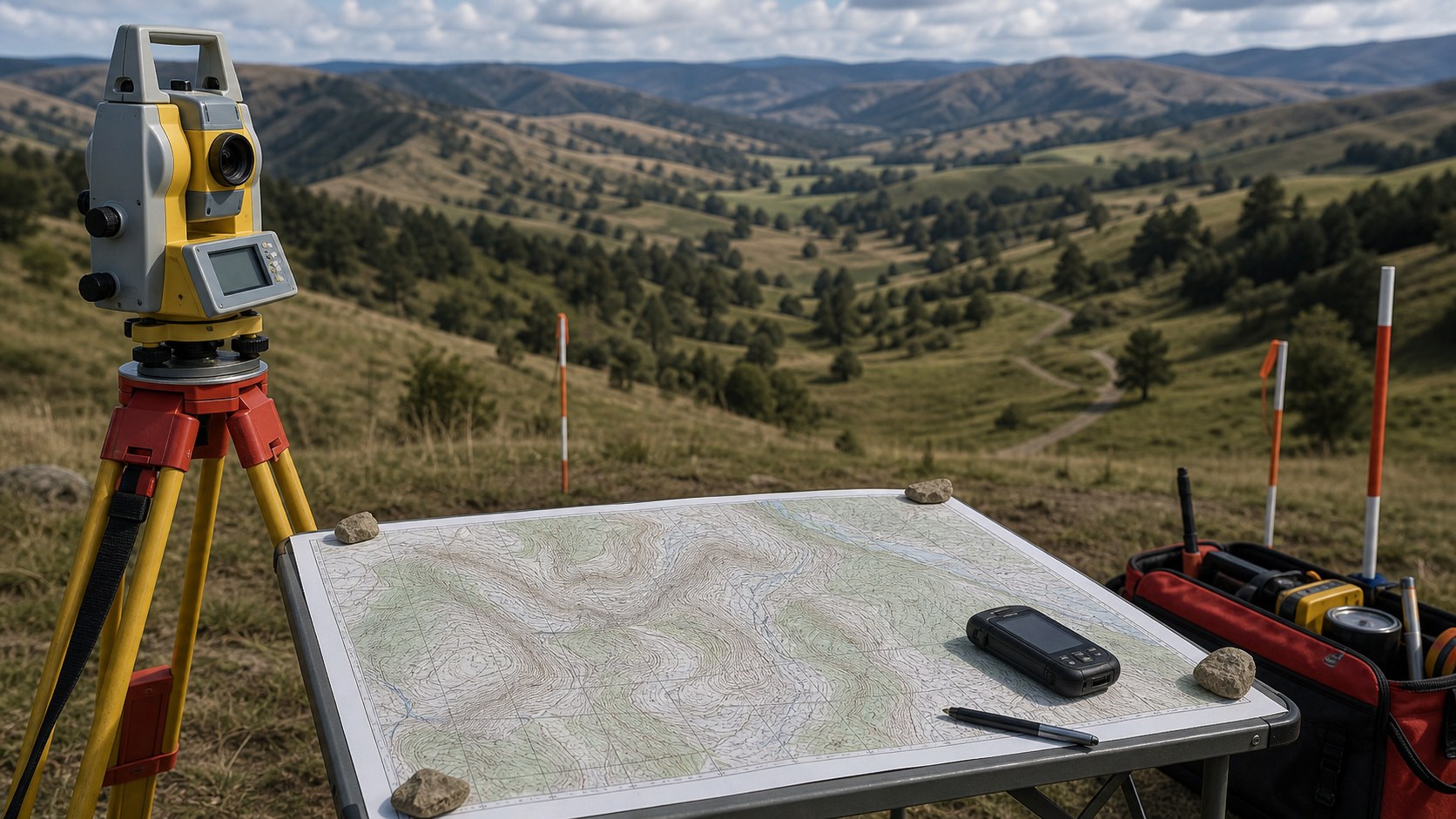
Topographic maps are the unsung heroes of navigation, overlaying intricate symbols onto paper to transform complex landscapes into comprehensible, practical guides. Whether you’re an intrepid backpacker plotting a multi-day traverse or an engineer assessing watershed boundaries, certain symbols prove indispensable. From the elegant loops of contour lines that whisper the secrets of elevation changes to the reassuring precision of bench mark icons, each symbol on a 2D topographic map carries its own story—of cartographic innovation, surveying challenges, and hidden historical quirks. In this countdown, we dive into the top ten most useful symbols found on these maps, exploring their origins, little-known facts, and why they remain vital to anyone who ventures off the beaten path.
#1: Contour Lines
Contour lines are the heartbeats of any topographic map, weaving sinuous curves that connect points of equal elevation. Introduced in the late 18th century by French cartographers such as César-François Cassini, these lines offered the first systematic way to depict three-dimensional terrain on a flat surface. Early survey teams—armed with theodolites, measuring chains, and field notebooks—would measure elevation at discrete points, then draft contour lines by interpolating between those points. Each contour loop tells a story: closely spaced lines signal steep cliffs or ridges, while gentle spacing indicates rolling hills or plateaus. The beauty of contours lies in their dual function: aesthetic elegance and functional clarity. Hikers trace these lines to identify ridgewalks and saddle crossings; hydrologists use them to delineate watershed divides; engineers refer to them when calculating cut-and-fill volumes for road construction. A lesser-known fact: in the Grand Canyon region, USGS cartographers opted for 100-foot intervals rather than the standard 40 feet to prevent the map from becoming a tangled mass of lines—an early example of tailoring contour design to regional terrain complexity. Modern digital elevation models (DEMs) can generate shaded relief and 3D visualizations, but many outdoor enthusiasts still swear by the tactile act of following contour lines with a fingertip, intuitively feeling the rise and fall of unseen hills. This blend of artistry, history, and irreplaceable utility cements contour lines as the most essential symbol on any topographic sheet.
#2: Index Contour Lines
While every contour line has its place, index contour lines serve as the map’s backbone—thicker, bolder lines that appear at regular elevation intervals (commonly every fifth contour). This differentiation was formalized in late 19th-century German cartography to aid readability: by accentuating every fifth contour, map readers can quickly gauge relative heights without counting dozens of adjacent lines. The technique crossed the Atlantic when the USGS adopted index contours for its 1:24,000-scale quadrangles in the 1890s. On these maps, the index lines not only guide hikers and engineers but also frame the map’s visual rhythm, creating a subtle grid of major elevation bands. Beneath each index contour, a small elevation value is often printed—providing a reference point from which to count minor contours. Anecdotes from early surveying expeditions describe lantern-lit evenings in field camps, where cartographers pored over drafts, carefully hand-inking every fifth line with slightly more pigment. In the rugged Appalachians, index contours have saved countless hikers from misjudging steep ascents by providing clear checkpoint elevations. Civil engineers, too, rely on index lines when modeling drainage patterns, using them to quickly approximate slope gradients over large areas. Though digital tools now render index contours automatically, the visual clarity they impart remains vital—ensuring that a single glance can reveal the lay of the land’s major elevation thresholds.
#3: Bench Marks
Bench marks (often abbreviated BM) are the cartographer’s gold standard for elevation accuracy: small triangles or “x” symbols paired with a precise numeric height denote surveyed points whose altitudes are known to fractions of a foot. Their history dates to the mid-19th century when European national mapping agencies began establishing leveling networks that spanned entire countries. In the U.S., the USGS and Army Corps of Engineers installed brass disks into bedrock or concrete—each engraved with a unique reference code and the year of placement—to create a backbone of vertical control. Field crews would haul heavy levels and graduated rods across rugged terrain, measuring tiny height differences between stations; these were then chained together in circuits to yield highly accurate elevations. A remarkable anecdote tells of a bench mark disk in the Sierra Nevada that survived an avalanche, only to be rediscovered 50 years later by a surveyor’s grandson. Today, bench marks form critical calibration points for GPS units: hikers and surveyors test their handheld devices against a map’s BM value to verify vertical accuracy. Civil engineers reference them constantly when designing road grades, ensuring smooth drainage and safe slopes. Although many older bench marks have been lost to construction or erosion, their presence on topo sheets serves as a tangible link to a legacy of precision surveying—making them among the most trusted, useful symbols on any map.
#4: Spot Elevations
Where bench marks offer pinpoint accuracy, spot elevations (often depicted as small black dots with accompanying height figures) provide flexible elevation readings at important natural or man-made locations: mountain summits, mountain passes, road junctions, or ridge saddles. Unlike bench marks, which are physically surveyed points, spot elevations may derive from aerial photogrammetry or DEM interpolation, yet they still supply critical elevation references across the map. Their widespread adoption by the USGS in the mid-20th century coincided with advances in aerial photography: cartographers could identify distinct points—such as a rocky outcrop or a highway interchange—and assign them precise heights. Spot elevations help hikers verify their progress: reaching a saddle printed at 8,540 feet confirms location and remaining ascent. Engineers planning pipeline routes use spot elevations to pinpoint cut-and-fill requirements at discrete bends. A surprising historical tidbit: during the mapping of Alaska’s North Slope in the 1950s, spot elevations were sometimes estimated from oblique reconnaissance photos taken during Operation Alaska Eagle, the Army’s early Cold War overflight program. While not as exact as bench marks, the sheer number and strategic placement of spot elevations on topo sheets make them invaluable waypoints and decision points for map users, earning them a coveted spot among the top ten symbols.
#5: Scale Bar
A map’s scale bar is its silent promise of distance fidelity, translating inches on paper into miles or kilometers on the ground. Although map scales have existed for millennia—in the form of verbal statements or simple ratios—the graphical scale bar, with its segmented divisions, became widespread in Renaissance Europe as printing techniques matured. By the 18th and 19th centuries, mapmakers understood that a visual bar allowed users to measure winding features—trails, rivers, ridge lines—by slicing a strip of paper against the bar, marking endpoints, and then transferring those marks onto the map itself. The USGS cemented the practice on its 7.5-minute quadrangles in the 1940s, offering dual bars for both metric and imperial measurements and sometimes including a “barbar” (dual-purpose bar that corrects for photocopy shrinkage or enlargement). The ingenuity of the barbar lies in tiny adjustment ticks at each end, ensuring that even if a map is reproduced slightly off-scale, its bar remains accurate within a known tolerance. Field scientists rely on scale bars when planning survey legs, aligning compass-edged paper strips to estimate distances between control points. Backcountry guides use them to calculate daily mileage for trekking itineraries, balancing scenic stops with daylight constraints. Today’s digital mapping platforms display scale dynamically, yet many professionals still print maps for remote expeditions—trusting the analog clarity of a well-calibrated scale bar to turn ink into real-world miles.
#6: Magnetic North Arrow
Navigation depends on understanding the relationship between true north (geographic north) and magnetic north (the direction a compass needle points), and the magnetic north arrow conveys this critical difference. Early maps simply used a single north-arrow symbol, but as compasses became ubiquitous in the 17th and 18th centuries, cartographers noted local magnetic declination—the angular difference between true and magnetic north—and began incorporating declination diagrams. The USGS standardized this practice in the 1920s, printing two arrows (one for true north, one for magnetic) separated by an angle measurement and an annual rate of change. This annual change—often a few minutes of arc per year—alerts users that the map’s baseline declination will gradually shift, requiring periodic adjustment. Naval chartmakers pioneered these diagrams to help mariners correct compass readings; on upland topo sheets, hikers rely on the magnetic north arrow to orient their compasses to map bearings, especially in dense forests or featureless tundra. Anecdotes from early Appalachian surveys describe teams recalcitrant to update declination values, leading to navigational mishaps when hikers followed outdated arrows. Modern GPS devices can auto-correct for declination, but the magnetic north arrow remains indispensable for any compass-based navigation, cementing its place among the top utility symbols on 2D topographic maps.
#7: Hydrography Symbols (Streams and Rivers)
Water is life—and on topographic maps, hydrography symbols annotate the lifeblood of every landscape: the rivers, streams, lakes, and springs that carve valleys and sustain ecosystems. Standardized in blue ink since the early 20th century by the USGS and Ordnance Survey, these symbols range from delicate single-line streams for minor creeks to bold double lines denoting perennial rivers. Texturing—such as intermittent-dash patterns—distinguishes seasonal waterways. The choice of line weight and pattern has practical origins: pale, narrow lines for ephemeral washes prevent clutter, while heavy, solid lines for major rivers stand out in low-light conditions or when a map is photocopied. A hidden gem: on some Alpine maps of the Swiss Siegfried series, stream symbols were overprinted with a faint green tinge to indicate trout habitat zones identified in 1920s ecological surveys. Hikers use stream crossings marked on topo sheets to plan water resupply points, and whitewater enthusiasts refer to line widths and adjacent contour shapes to infer rapid gradients. Hydrologists rely on these symbols to trace flow accumulation and delineate watershed boundaries. While satellite imagery now offers real-time water features, topo-map hydrography remains critical for ground-level navigation and planning, making it one of the most indispensable map symbols.
#8: Trail Symbols
Trails—the sinews that connect human journeys across wild terrain—are depicted on topo maps by distinct dashed or dotted lines, often with varying patterns to denote trail type: footpath, bridle path, or four-wheel-drive track. This symbology evolved in the early recreational mapping era of the 1930s when the US Forest Service recognized the need to guide hikers and horse riders through national forests. Standard patterns—such as short dashes for hiking trails and longer, spaced dashes for jeep roads—allow quick recognition even when overlaid on busy contour backgrounds. Early Forest Service mapmakers collaborated with trail-building crews to ensure every spur and switchback was recorded; log entries from the Civilian Conservation Corps detail surveyors marking new CCC-built trail alignments with flagging tape, then translating those bearings onto custom contour surveys. Modern adventure racers rely on these symbols to plot off-track shortcuts, while park rangers use them to estimate trail maintenance loads by measuring cumulative dash lengths. Unexpectedly, some historic trail symbols have become cultural artifacts: a rare zigzag dash on 1930s Appalachian maps once indicated a mule train route—today sought by equestrians tracing century-old packhorse corridors. The trail symbol’s ability to distill human passage into simple marks makes it an enduringly useful feature on any topo sheet.
#9: Road Classification Symbols
Not all roads are created equal, and topo-map users need to distinguish between interstate highways, paved secondary roads, gravel forest service roads, and overgrown logging tracks. Road classification symbols—usually a combination of line weight, color (black, red, or brown), and hatch pattern—evolved from 19th-century county atlases that hand-lettered road types in map margins. The USGS formalized the system in the 1940s: solid red for primary highways, solid black for paved roads, dashed black for unimproved roads, and double-dashed for four-wheel-drive tracks. This visual taxonomy allows drivers to infer vehicle suitability: a dashed double-line signals a rugged track best suited to high-clearance vehicles. Urban planners use these symbols to overlay demographic data against accessibility corridors, while search-and-rescue teams rely on accurate road depictions to plan egress routes. A lesser-known fact: during the mapping of Alaska’s Dalton Highway in the 1970s, cartographers developed a special red-brown symbol to highlight the new pipeline haul road, a prototype that influenced later USGS gravel-road symbols. Even in the age of GPS navigation, the ability to glance at a topo sheet and instantly recognize road quality remains crucial, securing road classification symbols a place on our list.
#10: Vegetation Cover Tint
While contour lines and symbols illustrate the land’s shape, vegetation cover tint reveals its living skin. Standardized in pale green by the USGS in the 1930s, these tints denote wooded areas, orchards, or mangrove swamps—areas where tree canopy or shrub cover exceeds a defined density. The origin of the green tint harkens back to color lithography breakthroughs in early 20th-century Germany, where cartographers experimented with overprinting color screens to evoke terrain character. On a topographic sheet, a wash of green signals denser forest—vital for hikers estimating undergrowth difficulty or firefighters planning fuel-break lines. Ecologists use these tints to assess habitat fragmentation, while radio engineers refer to canopy maps when modeling signal attenuation for microwave links. A surprising anecdote: during post–World War II remapping of Europe, some sheets used two shades of green to separate deciduous from coniferous forests, though this practice was later discontinued for simplicity. Today, while satellite-derived land cover offers granular classifications, the classic green tint remains a quick, intuitive cue on printed maps. Its gentle wash over valleys, ridges, and plateaus provides essential context—making vegetation cover tint one of the most useful and evocative symbols on any 2D topo map.
Each symbol on a topographic map embodies a legacy of exploration, technological innovation, and human ingenuity. From the looping elegance of contour lines to the subtle green wash of forest cover, these icons distill the world’s three-dimensional complexity into comprehensible, actionable art. Mastering these ten symbols unlocks a map’s full potential—guiding hikers, engineers, and geographers alike through unknown terrain with confidence, curiosity, and a deep appreciation for the cartographic craft.